Mazda Drift Cars: Rotary-Powered Legends
Mazda has earned legendary status in drift culture through its unique rotary engine technology and lightweight chassis design. The brand's commitment to driving dynamics and engineering innovation has produced some of the most iconic drift cars in motorsport history, from the legendary RX-7 to the grassroots favorite MX-5 Miata.
Rotary Engine Heritage in Drifting
The Wankel rotary engine defines Mazda's drift legacy. Unlike traditional piston engines, the rotary's compact size, high-revving character, and smooth power delivery make it ideal for drift applications. The 13B-REW twin-turbo rotary in the FD RX-7 produces linear power with minimal weight over the front axle, creating exceptional balance for sustained angle. Rotary engines rev to 9,000+ RPM, maintaining power through long drift transitions while producing the distinctive "brap" exhaust note that's become synonymous with drift culture.
RX-7 FC and FD: Rotary Icons
The FC RX-7 (1986-1991) and FD RX-7 (1992-2002) represent the pinnacle of Mazda drift car engineering. The FC's lightweight construction and 50/50 weight distribution made it a D1 Grand Prix favorite in the late 90s. The FD elevated this formula with its sequential twin-turbo 13B-REW producing 255-280hp, near-perfect weight distribution, and timeless design. Professional drifters like Nobushige Kumakubo piloted FDs to championship victories, while the aftermarket developed extensive support for 500+ horsepower rotary builds with single turbo conversions, bridge-ported engines, and standalone engine management.
RX-8 and MX-5 Miata Drift Platforms
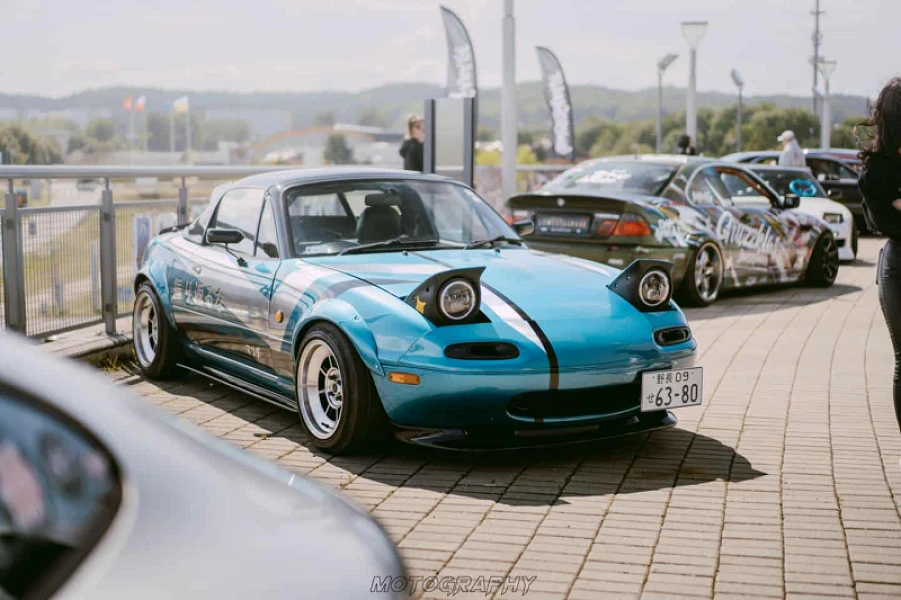
The RX-8 (2003-2012) brought rotary power to a more accessible package with its Renesis 13B naturally aspirated engine and unique suicide doors. While less common than the RX-7, the RX-8 offers excellent chassis dynamics and responds well to turbo conversions. The MX-5 Miata has become the world's most popular grassroots drift car across three decades of production. From the NA (1989-1997) to the ND (2016-present), the Miata's lightweight, rear-wheel-drive platform and perfect balance make it ideal for learning drift technique and competing in entry-level drift series worldwide.
Building and Modifying Mazda Drift Cars
Mazda drift builds typically focus on maximizing the rotary engine's potential while maintaining reliability. Common modifications include single turbo conversions (replacing the FD's sequential setup), upgraded fuel systems, aftermarket ECUs like AEM or Haltech, and reinforced apex seals. Chassis upgrades prioritize angle kits for increased steering lock, coilovers with 8-10kg/mm spring rates, welded or 2-way LSDs, and roll cages for competition use. The extensive aftermarket from companies like Feed, RE Amemiya, and Rocket Bunny ensures parts availability despite Mazda discontinuing rotary production in 2012.