
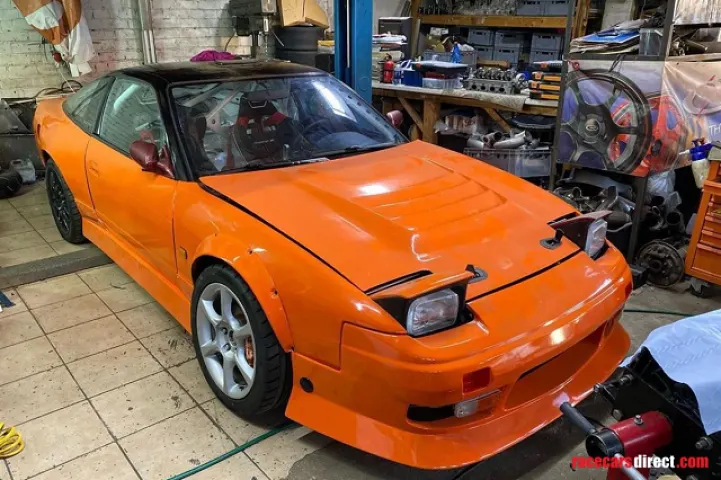
Nissan Silvia S13 / 180SX / 200SX / 240SX - Where everyone starts
The Nissan S13 is the car that built grassroots drifting. Sold as the Silvia S13 in Japan, 180SX for the hatchback, 200SX in Europe, and 240SX in North America, this chassis has more aliases than a con artist and more fans than most pop stars. Since 1989, this lightweight RWD coupe (or hatchback, depending on which side of the ocean you're on) has been teaching people how to go sideways on a budget. The recipe is dead simple: 50/50 weight distribution, multi-link rear suspension that actually communicates what the tires are doing, and the SR20DET turbo four in JDM spec. Pop-up headlights didn't hurt, either. The aftermarket figured out this chassis decades ago, so every part you could ever need already exists somewhere on a shelf or in a shipping container.
Same bones, different names
The S13 coupe (Silvia) came with either pop-up or fixed headlights depending on the year, and it's a touch lighter up front than the hatchback. The 180SX hatch gives you better weight transfer during transitions and spawned the whole "pig nose" front-end swap subculture (which is really just 180SX owners stealing Silvia bumpers, if we're being honest). In North America, the 240SX shipped with the naturally aspirated KA24DE instead of the turbocharged SR20DET, which means every 240SX owner's first mod is planning an engine swap. JDM cars got the SR20DET making 205hp from the factory, and the earliest models ran the rarer CA18DET. What matters is that every version shares the same drift-friendly bones underneath. Bolt on a steering angle kit, drop it on coilovers, weld the diff, and the S13 does exactly what you ask it to.
SR20DET - the four-cylinder that refuses to die
The SR20DET is a 2.0-liter turbo inline-four that makes 205hp and 203 lb-ft stock. Those numbers sound modest, and they are. But the bottom end on these things is absurdly strong for what it is, and that's the whole point. Slap on a front-mount intercooler, exhaust, and a tune, and you're looking at 300+ horsepower on factory internals -- enough to learn car control without the car trying to kill you every time you breathe on the throttle. The turbo spools from around 3,000 RPM, so you get usable mid-corner power for easy throttle-initiated oversteer instead of waiting for boost to arrive like a late pizza delivery. Serious builds push 400-500hp with bigger turbos, upgraded injectors, and standalone engine management. And because these engines are everywhere (especially in Japan), a replacement motor costs less than you'd think. For 240SX owners stateside, the SR20DET swap is basically a rite of passage at this point.
Why everyone starts here
The S13 weighs between 2,600 and 2,800 lbs. That's light enough to slide without needing big power, and balanced enough that the car does predictable things when you get on the gas mid-corner. The multi-link rear tells you what's happening before it becomes a problem, which is exactly what you want when you're still figuring out throttle modulation and weight transfer. Parts availability borders on ridiculous -- angle kits, suspension arms, aero, engine upgrades, all priced for people who just spent their savings on the car itself. Insurance stays cheap, body panels are everywhere from donor cars, and the mechanical layout is simple enough for garage builds on weekends. Daigo Saito and Vaughn Gittin Jr. both learned to drift on S-chassis platforms, and so have thousands of people you've never heard of. The S13 meets you where you are and keeps up as you get faster. That's not marketing -- it's just what happens when a chassis is this well-sorted from the factory.