Professional Drifting Explained — Rules, Scoring, Tandem Battles
Conor Shanahan rolls out of the corner at PGE Narodowy. 53,000 fans on their feet. Paweł Korpuliński leads the OMT run, fighting for the Warsaw round win. And then — in one of the final zones — he runs wide by half a meter. The judges raise their hand: round goes to Shanahan. The championship was already locked for Shanahan hours earlier (Piotr Więcek's GR Supra had a mechanical failure in TOP 32), but this one battle decided the night. That's how professional drifting works: the fastest car doesn't win — the driver who controls a sideways car best does.
If this is your first time watching drift, it looks chaotic, but it runs on rules tighter than F1's. This guide breaks down the full mechanic — from the course with its clips and zones, through the scoring criteria, into the format of tandem battles and that moment when judges raise two fingers and the crowd loses it: OMT.
Pro drift isn't a race — bust that myth first
The most common question from anyone in the grandstands for the first time: "Who wins? The fastest one?" No. There's no clock in drift. No finish line where a chronometer fires. The driver who convinces the judges most — with the car's angle, line through the course, and style — wins.
It's closer to figure skating than Formula 1. Drivers get a points score, a single-elimination bracket cuts losers, the final crowns a champion. Speed only matters in one dimension: whether the driver uses the full width of the track and goes fast SIDEWAYS — not whether they cross a line first.
If you want to back up to absolute basics — what drift is as a technique, why it requires rear-wheel drive, how it's different from doing donuts in a parking lot — we have a separate piece: what is drifting and what it definitely isn't. Here we stay with competition.
What pro drifting is
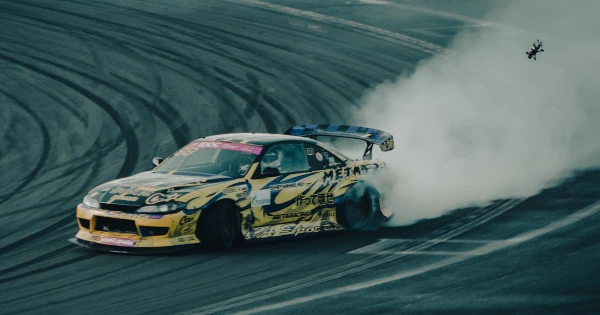
Professional drifting is a motorsport discipline built on controlled oversteer of a rear-wheel-drive car. The driver intentionally throws the car into oversteer and holds it through the entire corner. Slip angles hit 45-60 degrees, speeds at top events touch 150 km/h (93 mph). Under the hood — engines pushing 600 to 1,100 hp typically, more at the very top of the field. One badly timed throttle input and the car's in the wall.
The sport was born in Japanese mountain roads in the 1970s. Keiichi Tsuchiya turned it into a discipline. Today Europe has Drift Masters Grand Prix, the US has Formula Drift, Japan has D1 Grand Prix. In Poland we've got Drift Masters with the final in Warsaw, Driftingowe Mistrzostwa Polski (DMP), and Drift Open. All of them use the same standardized system — 100 points per run, judged scoring, single-elimination bracket.
And it's not the street. Pro drift only happens on closed tracks with barriers, medics on standby, a roll cage in the car, and a driver in a fire suit. What you sometimes see in parking lot videos has nothing to do with pro drift — same word, very different sport.
The course — clips, zones, and the ideal line
Before judges start counting points, the organizer draws the course. It's not the whole track — it's a chosen section where the competition unfolds. The course has a few elements you need to know to follow what's happening trackside.
Clips (clipping points) are vertical pylons set on the inside edge of a corner. The closer the driver passes the clip with their rear or front bumper, the more line points they get. The best brush them by millimeters. Some clips need to be physically tapped (touch & go), others just grazed.
Zones are painted strips on the outside edge of a corner. The car has to FILL the full width here — ideally the rear wheels touching the outside line of the zone. Failing to fill a zone costs you points.
The ideal line is the path through the section drawn up by the judges, connecting clips and zones. Each corner has a description: where the car should be mid-drift, where to accelerate, where to slow down. All of this is in the driver briefing before the first run.
Drift Masters adds something most coverage doesn't translate: the accel/decel map. The course is broken into colored sectors:
- Green: car must be accelerating or at least holding speed. Slowing down = deduction.
- Red: handbrake, footbrake, or off-throttle is allowed. Chase driver should expect it.
- Orange: small speed adjustments OK, but no aggressive braking.
The map also serves as the reference for fault calls in tandem collisions. If lead slows in a green sector and chase rear-ends them — that's lead's fault, not chase.
Event format — from qualifying to the final
A typical drift weekend has the same skeleton everywhere: Friday is practice and qualifying, Saturday is the bracket. The full machine starts at TOP 32 and ends at the final. Two or three days of work, a dozen-plus hours of track action.
Qualifying. Each driver gets TWO solo runs — in reverse championship order (worst first, champion last). Best of two scores counts. Top 32 advances to the bracket. The rest goes home.
Quali Showdown (Drift Masters specific). Top 4 from qualifying battles for bonus championship points: 1 vs 4, 2 vs 3, then winners against each other (1st = 4 pts, 2nd = 3, 3rd = 2, 4th = 1).
Tandem bracket. TOP 32 → 16 → 8 → 4 → final. Each battle is two runs in pairs: one driver leads, the other chases; then they swap. The higher qualifier gets a privilege — they pick whether to start as lead or chase. Three judges vote majority on who was better across both runs combined.
Bye Run. If your opponent's car can't get to the line, the advancing driver has to do a "bye run" — an unjudged lap proving their car is mechanically sound. Just initiate drift at the first corner; can finish driving normally or keep drifting — driver's choice.
Time between runs. After the first run, the start judge fires a two-minute timer. Both drivers have to be back on the start line and ready. Late = disqualification.
The four scoring criteria — what judges actually count
This is the heart of everything. Drift Masters in 2025 scores a qualifying run on 100 points, split into three main categories:
- Line — 60 points (THE MOST)
- Angle — 20 points
- Style — 20 points (broken into 3 sub-categories)
This is the biggest surprise for new fans: line is 60% of the score. Not angle, not speed, not flair. Line. The driver has to hit where the judges drew it — clips, zones, touch & go. Mess up the line, even with picture-perfect angle and a screaming engine, and you'll lose to someone who drove modestly but exactly where they were supposed to.
Line (60 pts)
Points are awarded for sticking to the line set in the briefing. The 60-point pool is broken into track sectors — each weighted differently. Two line judges can use half-points (e.g., 47.5/60). Final line score is the average of their two scores.
Angle (20 pts)
Bigger slip angle = more points — provided it doesn't cost speed in acceleration zones. Full lock with the throttle pinned = max points. Reducing angle to bail out before a wall = less. Angle is also broken by sector (you might get 18/20 in sector 1 and 12/20 in sector 3).
Style (20 pts)
Three sub-categories:
- Initiation (5 pts) — early flick (cones mark the latest initiation point), quick to target angle, no corrections. Lazy = fewer points. Spin on initiation = zero.
- Fluidity (10 pts) — smooth rotation in transitions (direction changes), high lock-to-lock angle held throughout, the car settles and flows through the course without bucking.
- Commitment (5 pts) — consistent throttle, holding pace, using the full track width. Key phrase from the rulebook: "Make it look dangerous — approach barriers with confidence." Translation: drive like you don't care, but you do.
How the judges split it
Three judges. Each watches something different:
- Judge 1: 60 pts line
- Judge 2: 60 pts line + 5 pts commitment
- Judge 3: 20 pts angle + 5 pts initiation + 10 pts fluidity
Lines get averaged, the rest get summed. Top drivers regularly score 90+. A perfect 100 has never happened. The loudest run of recent years is Kalle Rovanperä's 99/100 in Poland in 2023 — the benchmark for what a near-flawless run looks like:
Scoring systems — DM, DMP, Drift Open side by side
All major Polish and European series use a 0-100 scale, but they distribute points differently. Quick comparison:
| Series | Line | Angle | Style/Other | "Good run" threshold |
|---|---|---|---|---|
| Drift Masters (DM) | 60 | 20 | 20 (5+10+5) | ~85+ pts |
| DMP / Drift Open | dominant | significant | style + impression | 80+ = good, 90+ = very good |
DMP uses the same three-judge setup. From the DMP sporting regulations: a run scored above 80 points is a good run; above 90, very good. Drift Open uses a similar split in its Pro/Am classes.
Practical difference? Small. If you understand DM logic — line is king, angle second, style third — you understand DMP and Drift Open too. Each series has nuances in their briefing, but no one has flipped the pyramid. Line always weighs the most.
Tandem battles — the heart of competition
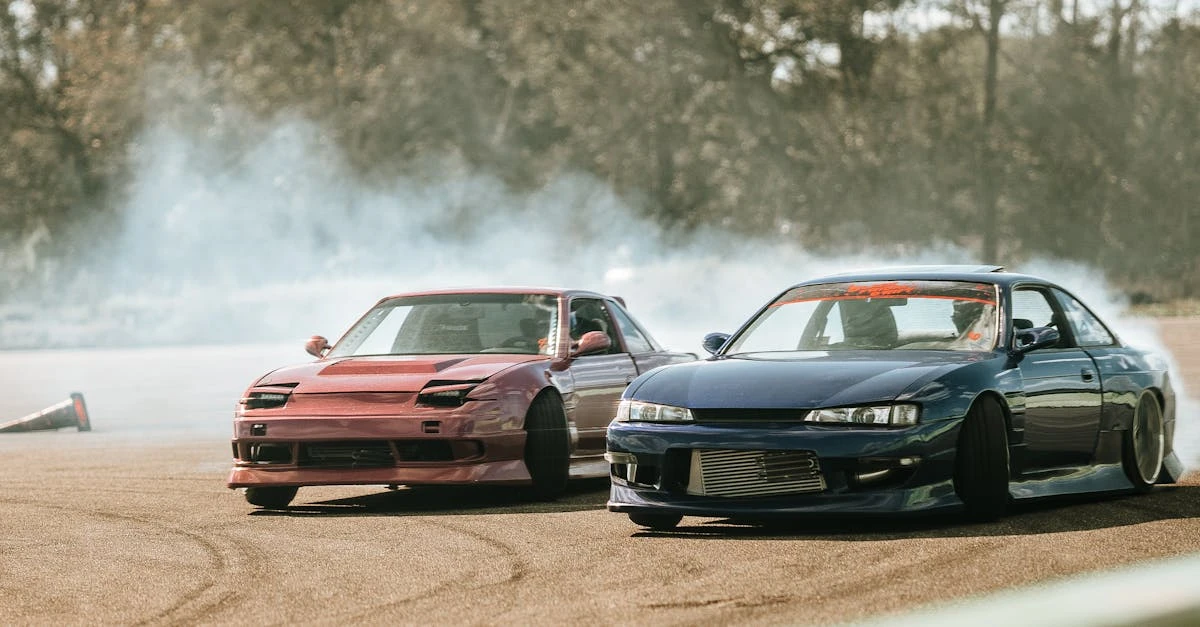
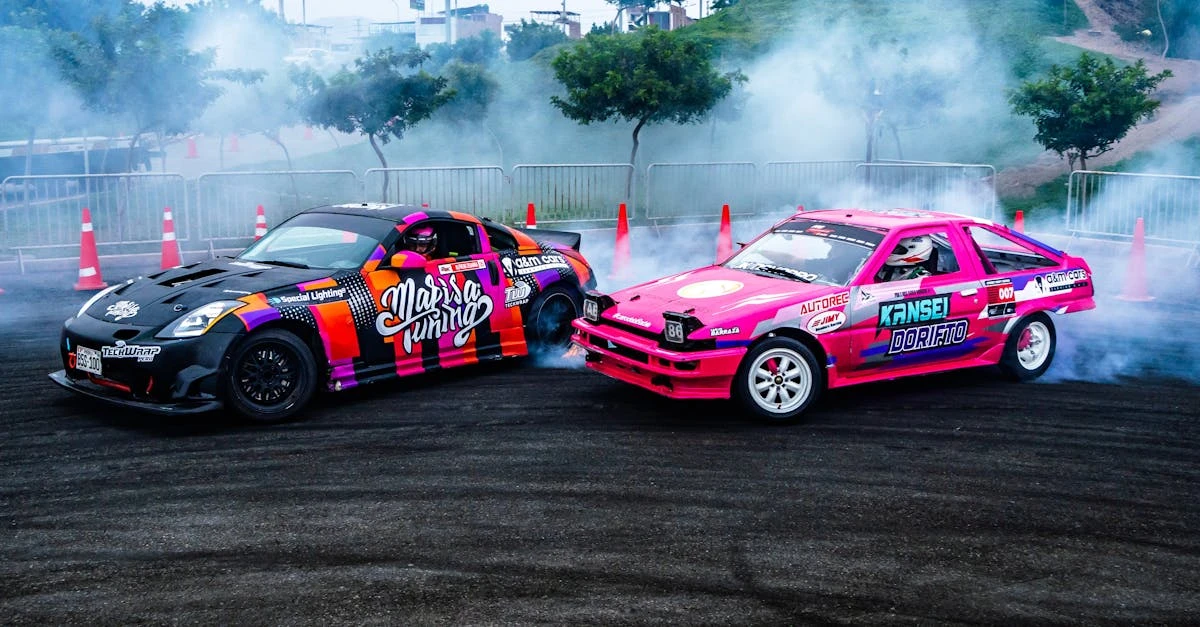
This is where the real fun starts. After qualifying, the bracket fires up and every battle is TWO runs in pairs: one driver leads, the other chases. Then they swap. Judges look at the sum and decide who advances.
Top-shelf example — Drift Masters 2025 Grand Finale TOP 16 at PGE Narodowy, tandem on full tilt:
Lead and chase — who's responsible for what
The key rule most fans don't know: lead is worth 60% of the battle, chase is worth 40%. DM rulebook logic: it's hard to have a good chase run if the lead didn't set one up properly. So the lead driver's run weighs more.
Lead has four jobs:
- Drive the qualifying line
- Have the potential of a 100-point run
- Leave the chase a "chaseable lead" — filled zones, hit clips, consistent speed, so the chaser actually has something to mimic
- Stick to the accel/decel map
Chase has its own:
- Initiate NO LATER than the lead
- Stay close (ideally door-to-door) for as long as possible
- Match the lead's angle or beat it
- Mimic the lead's line, transitions, and pace
Initiation — side by side or single file
The course is split into two lanes by a painted line. The chase driver picks the initiation procedure (unless the judges restrict it):
- Side by side: chase initiates next to lead, in their own lane, without crossing the center line. Gives the lead full lane width to initiate however they want, gives the chase a shot at proximity from the first meter.
- Single file: chase stays behind the lead in the same lane, as close as possible, doesn't initiate until the lead does. More conservative, more control.
Proximity box — when chase scores zero
The judges designate a "proximity box" — a section on the course where both cars MUST be together. If the chase driver doesn't get even a front bumper inside the box, they get an INCOMPLETE for the entire run. Result = zero on chase. There can be more than one proximity box per course.
Passing — when it's legal
Rare, but possible. Chase can pass the lead, but only if ALL FOUR DM rulebook conditions are met simultaneously:
- Lead is offline or completely off course.
- The pass is made only at an inside clipping point.
- The pass is only made on the inside of the lead.
- Chase becomes the new lead only at the moment they fully clear the lead's car.
After a legal pass, the chase takes over the lead role for the rest of the run and is judged like the lead. The passed driver gets an INCOMPLETE.
OMT — One More Time
If after two runs the judges can't agree on a winner — they call OMT (One More Time). Both drivers run lead + chase again. Fresh battle, fresh shot.
A few rules worth knowing:
- Only ONE OMT per battle. You don't get a second one.
- If after OMT there's still no majority — the judges go back to the original two runs and pick a winner from those.
- OMT isn't for sloppy battles. The judges can decide that if both screwed up, the one who screwed up less wins without an OMT.
This is where drift history gets written. Drift Masters 2025 Grand Finale at PGE Narodowy — Conor Shanahan vs Paweł Korpuliński, fighting for the season's last round win. The championship was already locked for Shanahan (Piotr Więcek's mechanical failure in TOP 32 had closed the math), but the round in Warsaw was still open. Two runs, tied. OMT. Korpuliński leads cleanly, close to the walls — and runs wide in one of the final zones. Judges raise their hand for Shanahan. Round win to the Irishman, second place in the final to the Pole. 53,000 in the stadium bowl, the year's last battle decided in the last meter.
A collection of the loudest OMT moments across series (FD, DM, RDS, D1GP) — the crowd reaction when judges hold up two fingers is one of the things you don't forget:
Mistakes, deductions, and zeros — where points get lost
Drift is a sport where one second decides everything. The penalty scale runs from "minus a few points" (deduction) to "zero, you're done, drive home" (incomplete).
Deductions
Deductions lower the score but don't kill the run. From the DM rulebook:
- Double initiation
- Tire off course
- Missed zones or clips
- Short straightening (correction)
- Off line
- Lack of angle
Incomplete (zero)
These are the mistakes that drop a run to 0 points:
- Spinout (car rotated around its own axis after losing drift)
- Opposite drift (counter-steer in the wrong direction for the corner)
- Stopping the drift mid-scored section
- Hood / doors / hatch opening during the run
- Two wheels off the marked track (some tracks: three)
Tandem-specific
Specific to tandem runs:
- Illegal pass (chase didn't meet the 4 conditions) = INCOMPLETE for chase
- Getting legally passed = INCOMPLETE for lead
- Chase intentionally not chasing after a previous incomplete = INCOMPLETE
- Three failed starts in a row (driver-fault or by judge's call) = INCOMPLETE
- Chase didn't make it inside the proximity box (not even with the front bumper) = INCOMPLETE
Contact — who's at fault
Drift Masters writes it bluntly in the rulebook: "Vehicle contact is part of the sport." But there are rules:
- Lead's fault: if lead loses drift, goes off line, or unnecessarily slams the brakes — and chase rear-ends them.
- Chase's fault: if chase hits the lead while the lead is doing their job correctly.
- The driver judged not at fault gets up to 10 minutes to repair before the second run (20 in the final).
- If both wreck independently, no fault — winner = higher qualifying position.
Naoki Nakamura, the Japanese legend, in 2025 set the benchmark for angle and style — this is the level the angle/style scoring is calibrated against:
Championship points — how the season counts
Each round generates points toward the season standings. Drift Masters distributes them like this:
Qualifying points (for qualifying position):
- 1st — 8 pts
- 2nd — 7
- 3rd — 6
- 4th — 5
- 5th — 4
- 6th — 3
- 7th — 2
- 8th — 1
Quali Showdown (Top 4 from quals):
- 1st — 4 pts
- 2nd — 3
- 3rd — 2
- 4th — 1
Bracket points:
- 1st place: 100
- 2nd place: 88
- 3rd place: 76
- 4th place: 64
- 5-8: 48
- 9-16: 32
- 17-32: 16
It sums across the season. Ties broken by number of higher finishes; if still tied — finishing position in the most recent round.
Conor Shanahan finished the 2025 season with 490 points, Piotr Więcek — runner-up — with 406. The 84-point gap is roughly one round win.
How to watch drift like you actually know what's happening
Three things to start watching for, and you'll see something different on track than the rest of the grandstand:
- Watch the line first. It's 60% of the score. If a driver hits the clips and fills the zones, they'll probably win — even if someone else ran sharper angle.
- In tandem, watch the chase's front bumper relative to the lead's rear quarter. Chase doesn't aim for the rear bumper — it aims for the area around the lead's rear wheel and door, ideally door-to-door. The closer they hold that line, the more points. Drop 5 meters back and the points evaporate.
- Listen to the crowd at OMT. That's the moment the judges can't decide. The atmosphere goes nuclear, the drivers are spent, and the cars — often barely holding together. Best moment of the weekend.
Live timing is at dm.gp — the bracket updates in real time. Even sitting in the grandstand, keep your phone out, because you'll figure out who's running next way faster than the announcer tells you.
Best way to learn? Show up. There are tracks and training days across Europe and the US. Find one near you:
Drift season is on.
Drift events, training days, and competitions — full calendar across Europe.
Frequently Asked Questions
Is professional drifting about being the fastest?
No. Drift is a sport judged subjectively by judges. What counts is line through the course (60% of the score), slip angle (20%), and style (20%). Speed only matters in acceleration zones — total run time isn't measured.
What is OMT in drift?
OMT (One More Time) is a tandem tiebreaker. If after two runs the judges can't agree on a winner, the drivers run lead + chase again. Only one OMT per battle. If still tied after OMT, judges go back to the first two runs and decide based on those.
Who wins a tandem — lead or chase?
Either can win. The judges sum the scores from both runs: lead's points weigh 60% of the battle, chase weighs 40%. Logic: it's hard to chase well if the lead didn't run well. Whoever was better across both runs combined wins.
What is an incomplete run in drift?
An incomplete (sometimes called a "zero") is a series of major mistakes that drop the run to 0 points: spinout, opposite drift, stopping the drift, opening hood or doors, two wheels off the marked track. In tandem, additionally: illegal pass, no entry into the proximity box.
Can the chase pass the lead?
Yes, but only if all four conditions are met simultaneously: lead must be offline or off course, the pass only at an inside clipping point, only on the inside of the lead, and chase becomes the lead only after fully clearing the other car. Any other pass = INCOMPLETE.
How is Drift Masters scoring different from DMP?
Both use a 0-100 scale and the same main criteria (line, angle, style). Drift Masters splits it precisely: line 60, angle 20, style 20 (5+10+5). DMP uses a similar split with line dominant — the DMP sporting regs call a run above 80 points "good" and above 90 "very good." The practical difference is small — if you understand DM, you understand DMP too.