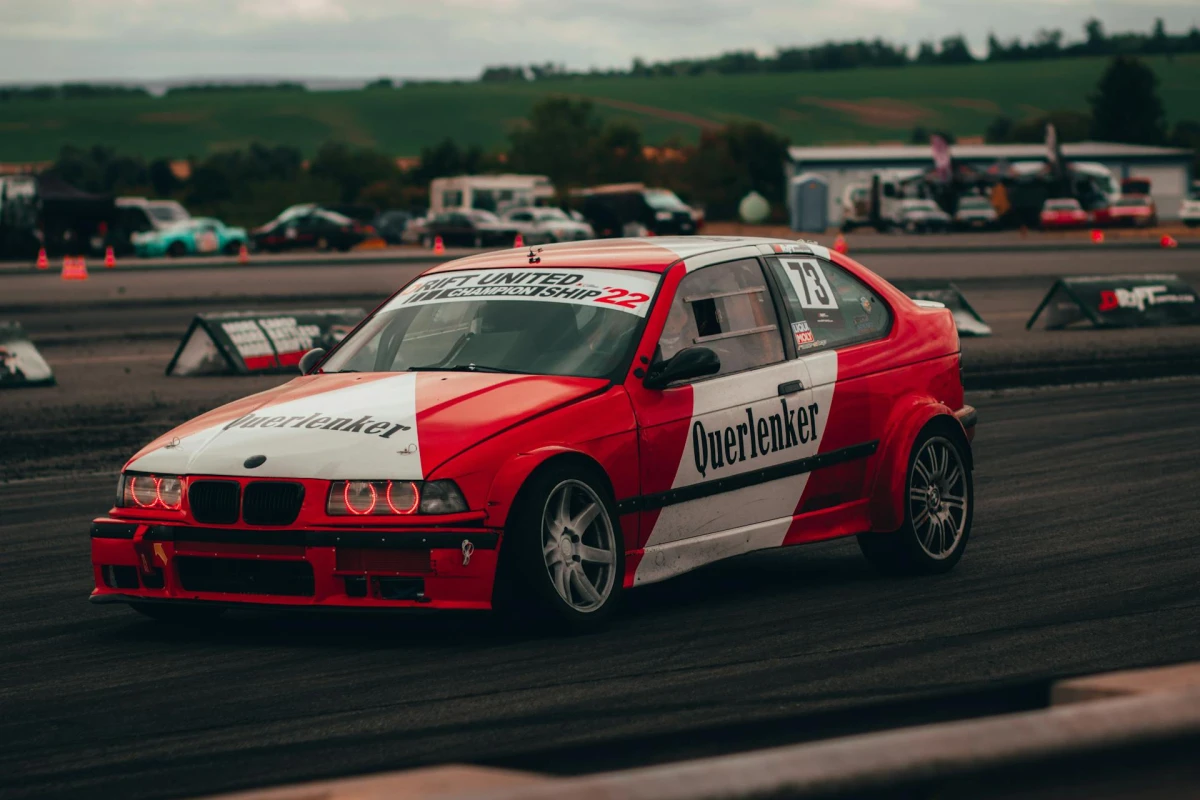
BMW E36 Drift Build — The Complete Guide
The BMW E36 is the most popular drift platform on the planet. Rear-wheel drive, inline six, around 1,300 kg (2,870 lbs), and cheap enough that you can buy one, weld the diff, and be on track next weekend. Parts are everywhere — junkyards, eBay, Facebook Marketplace, your buddy's garage. Half the cars at any grassroots drift day are E36s in various states of destruction.
This guide takes you from buying the car to your first track day and beyond. Real prices, real part recommendations, and a mod order that makes sense.
Sedan, Coupe, or Compact
The E36 came in several body styles. Each has its strengths and you'll find all of them on DriftHub.
Sedan is the best base for a serious build. The extra B-pillar gives structural rigidity that the coupe doesn't have without a cage. The interior is roomier, so fitting a cage and a helmet with a bucket seat is easier. And here's the surprise: the sedan is actually lighter. A 325i sedan weighs about 1,295 kg (2,855 lbs), the coupe about 1,330 kg (2,932 lbs)1. The two-door body needs extra reinforcement to hold together without four roof pillars.
Coupe looks the best and nobody argues with that. Shorter wheelbase gives quicker transitions. Less rigid without a cage, but for practice days that's not an issue. Most people buy the coupe because they want a good-looking car.
Compact (323ti/318ti) is its own thing. It runs E30 rear suspension — semi-trailing arms instead of the E36's multilink. Over 20 cm (8 inches) shorter than the sedan, which means snappier transitions and less mass to transfer between turns. Cult car with rising prices, but rear suspension parts are harder to find. Not ideal for competition, but for practice days it's a blast.
Touring (wagon) — the rarest sight at a drift event, but they exist. Heavier than the sedan due to the longer rear and cargo structure. Practical if you want to drive to the track and throw your tires in the back. Not ideal for drifting, but it works.
Convertible — no. Too heavy, too weak structurally. A waste of money and time.
Which Engine and What to Check Before Buying
The M50 and M52 inline sixes are the backbone of every budget E36 drift build. Both are reliable as long as you don't overheat them.
| Engine | Displacement | Power | Torque | Notes |
|---|---|---|---|---|
| M50B25 | 2,494 cc | 189 hp | 181 lb-ft | Cast iron block, no VANOS, simplest |
| M50B25 TU | 2,494 cc | 168 hp | 181 lb-ft | Cast iron block, with VANOS |
| M52B25 | 2,494 cc | 168 hp | 181 lb-ft | Aluminum block, lighter |
| M52B28 | 2,793 cc | 190 hp | 207 lb-ft | Aluminum block, more torque |
The M50 has a cast iron block, which is a huge advantage for drifting and turbo builds. Cast iron handles thermal and mechanical stress far better than the M52's aluminum. The problem is that M50s are getting harder to find. Most E36s on the market have an M52 under the hood, and that's what you'll likely end up with. The M52 is lighter and has more torque in the B28 version, but the aluminum block is more sensitive to overheating — which is why cooling system refresh is job number one before hitting the track.
Start with an M52B25 or M52B28 in a 323i/325i/328i. The 316i and 318i (four-cylinder) don't have enough power to hold angle through longer sweepers. The M54B30 was never factory-fitted to the E36 — it's a swap from the E46/E39 that people do for 228 hp on stock internals.
What to Check Before Buying
Cooling system — this is the engine killer in E36s. Plastic thermostat housings, plastic water pump impellers, plastic expansion tanks. Everything cracks after 50–60k miles. Ask about replacement history. If nothing's been replaced, knock $250 off the price and do it yourself before your first track day.
Rear subframe — cracks at the differential mounting points under drift loads. Look for cracks near the welds and deformation. Subframe reinforcement plates are cheap insurance ($50–100 for plates, $100–200 for welding).
VANOS (M50 TU and M52) — BMW's variable valve timing system. Seals degrade over time. Symptoms: rough idle, power loss in the low range. Rebuild kits run $50–100.
Oil — M50/M52 engines can burn 1 liter per 1,000 km when rings are worn. Blue smoke on cold start = rings. Check the oil level and ask questions.
Look on Facebook Marketplace, Craigslist, OfferUp, and drift community groups. In Europe, check mobile.de, Otomoto, and OLX. For a filtered drift-specific search, check BMW E36 listings on DriftHub.
Looking for a drift car?
Browse listings and read our buyer's guide
Prices in 2026: A rough project E36 with a running 2.5L or 2.8L engine goes for $1,500–$4,000 in the US (€1,500–€3,000 in Europe). A clean example with service history runs $6,000–$13,000 (~€5,000–€10,000).
Before You Hit the Track
Before the welded diff and the hydraulic handbrake, do the boring stuff. This decides whether your engine survives the first track day.
Replace the entire cooling system. Aluminum radiator ($150–300 aftermarket), thermostat, water pump with a metal impeller, hoses, expansion tank. Total cost with labor: $300–600. Sounds like a lot, but an M52B28 after overheating means a head replacement at triple that.
Reinforce the rear subframe. Reinforcement plates cost $50–100. Welding at a shop: $100–200. Without this, the subframe cracks on your third or fourth track day.
Fresh fluids — oil, brake fluid (DOT 4 minimum, DOT 5.1 for track use), coolant. Check your brakes — pads and rotors need to be in good shape. Brakes are safety, not savings.
Stage 1 — The Minimum to Drift
With the car inspected and the cooling system refreshed, time for the mods that make drifting possible.
Welded differential — $100–$300 at a local shop. You take the diff out, drive to a welder, come back with a diff that locks both rear wheels permanently. It's loud on the street and terrible for daily driving, but on track it does exactly what you need. An LSD ($400–800 used) is the next step up — more durable, quieter, and smoother.
Hydraulic handbrake (hydro) — entry-level units start around $240 (GKTech budget kit). Premium setups run $600–960. You can set it up two ways: tapped into the main brake system (cheaper) or with a dedicated caliper on a separate circuit (better but more expensive). Without a hydro, you're left with flick initiations (steering input + throttle) or clutch kicks — doable, but a hydro gives more control and lets you manage the car mid-drift.
Bucket seat + harness — a non-FIA bucket runs $150–360 (NRG FRP-300 is popular at ~$360). A 4-point harness: $80–200. They keep you planted when the car is sideways at 45°. A stock seat with a three-point belt doesn't do that.
Fire extinguisher — $20–50. Required at every track event, no exceptions.
Tires — buy the cheapest rears you can find. You'll destroy them. Prepare 2–3 sets of rear tires for one practice day. Put something better on the front — that's where you need grip.
Stage 1 budget (with car): approximately $3,000–$5,000 (€2,500–€4,500). That gets you a car that can go to an open practice day.
Stage 2 — Suspension and Alignment
Stock E36 suspension is soft and gives you no feedback. Coilovers are the biggest change you'll feel after the welded diff.
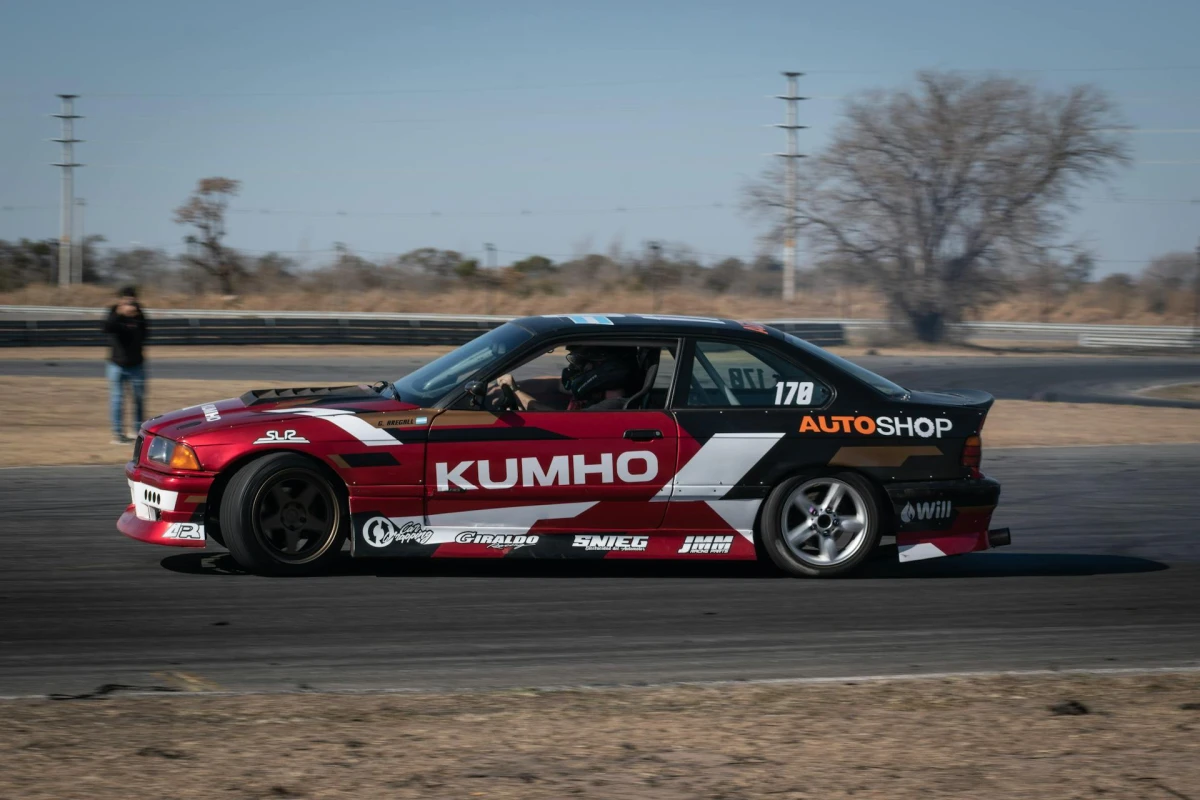
Budget coilovers (FK, Raceland, used BC Racing) cost $400–900. New BC Racing BR series run $1,215–$1,4152, but they hold their value and can be rebuilt. Budget coilovers are fine to start — just make sure they have adjustable damping.
Spring rates: 10–12 kg/mm (560–670 lb/in) front, 5–7 kg/mm (280–390 lb/in) rear. Stiffer front gives stability, softer rear allows more traction.
Alignment — more important than the coilovers themselves:
- Front camber: -3° to -4° (more tire contact in the turn)
- Caster: 7°+ (self-centering steering, stability in angle)
- Front toe: 2–3 mm out (quicker turn-in)
- Rear camber: close to 0° (maximum rear axle grip)
- Rear toe: 1–2 mm in (stability)
Polyurethane bushings — replacing the rubber bushings with poly in the control arms and links gives precision that rubber can't. Runs $100–250 for a full set, and the difference in feedback is huge.
Stage 2 budget: $800–$1,800 (€700–€1,600).
Stage 3 — Steering Angle
Stock E36 steering turns the wheels about 30°. That's not enough to hold deep angle in a drift. More steering lock = more control = longer runs sideways.
You can increase steering lock in two ways: steering adapters (mounted on the knuckles, change the steering geometry) or adapters + extended lower control arms (a full kit that gives maximum angle and better suspension geometry at full lock). Cheaper kits are adapters only. More expensive ones include adapters, control arms, and sometimes tie rods.
Rack spacers (~$30) are the cheapest way to get a few extra degrees. Shims between the steering column and rack. The effect is modest but good enough to start.
PMC Motorsport Stage 1 (€89 / ~$95) — steering adapters from a Polish manufacturer. About 25% more lock than stock. Great value and available through European drift shops3. They also offer a Stage 3+ with adjustable rods at €315.
Wisefab (~$2,200 / €1,310) — the full kit: adapters + extended control arms. Over 60° of steering lock4. Used at Drift Masters and Formula Drift level. If you're planning to compete seriously, this is the investment that pays for itself.
CNC71 — another European manufacturer offering both adapter-only and full kits with control arms. Worth checking, especially if you're looking for something between PMC and Wisefab.
What does more angle actually give you in practice? Deeper tandems, easier transitions, less risk of spinning in the middle of a turn. You'll feel the difference from your first run.
Stage 3 budget: $30–$2,200 (€30–€1,310) depending on ambition.
Stage 4 — Cage and Safety for Competition
For practice days, a cage isn't required — bucket seat, harness, and fire extinguisher are enough. But if you want to compete in any sanctioned series, a roll cage becomes mandatory.
CYBUL V1 — a weld-in cage kit from Poland for just €198 ($215)5. The V3 with extra bracing is €245 ($265). Then add welding labor: $400–$1,000 depending on the shop and scope. In the US, weld-in cage kits from domestic manufacturers (Autopower, Roll Cage Components, Cagekits.org) run $1,200–$2,750 for the kit alone6.
FIA bucket seat — Sparco Sprint at ~$479 (€440)7. A non-FIA bucket runs $150–360 — fine for practice, but competition requires homologation.
4 or 6-point harness with FIA homologation: $150–400 (Sparco, OMP, Schroth).
Stage 4 budget: $1,000–$4,000 (€800–€3,500).
Stage 5 — More Power
Don't rush this stage. 168–190 hp from M50/M52 engines at 1,300 kg is plenty to learn on. More power without skill means more broken cars and less time on track.
When the foundation is solid:
M52B28 swap is the simplest step up. 207 lb-ft of torque makes a difference on corner exit. The engine bolts right in (same mounting pattern), and total cost with labor runs $800–1,500 for a used engine plus the swap.
Turbo is a different league. Verified builds on Polish dynos (Boost Factory, Turbo-Lamik)8:
- M50B25 + GTX30: 503 hp / 539 lb-ft
- M52B28 + GT3530: 434 hp / 406 lb-ft
- M54B30 (swap) + GT35: 562 hp / 553 lb-ft
For turbo you need a standalone ECU (EcuMaster EMU Black, Haltech, Link), reinforced fuel system, intercooler, and exhaust manifold. Budget for the turbo setup with tuning: $3,000–$8,000+. It doubles what you've spent so far.
How Much Does It Cost — Budget Table
| Stage | What you get | Cost (USD) | Cost (EUR) | Running total (USD) |
|---|---|---|---|---|
| Car + prep | E36 with 2.5/2.8 + cooling + subframe | $2,000–$14,000 | €1,800–€11,000 | $2,000–$14,000 |
| Stage 1 | Welded diff + hydro + seat + harness + extinguisher | $500–$1,500 | €450–€1,300 | $2,500–$15,500 |
| Stage 2 | Coilovers + alignment + bushings | $800–$1,800 | €700–€1,600 | $3,300–$17,300 |
| Stage 3 | Angle kit | $30–$2,200 | €30–€1,310 | $3,330–$19,500 |
| Stage 4 | Cage + FIA seat + harness | $1,000–$4,000 | €800–€3,500 | $4,330–$23,500 |
| Stage 5 | Turbo + ECU + supporting mods | $3,000–$8,000+ | €2,700–$7,000+ | $7,330–$31,500+ |
Minimum for an open practice day: $3,000–$5,000 (car + welded diff + hydro + seat). Full competition setup without turbo: $4,300–$23,500. With turbo: $7,300+.
European builders can save significantly on parts by sourcing from Polish manufacturers (CYBUL cages from €198, PMC angle kits from €89) — often 50–70% less than US equivalents.
Looking for a BMW E36?
Browse drift car listings from people who actually drift
Where to Drive
You've got the car, the welded diff, the hydro. Now you need a track.
Most regions have grassroots drift events and open practice days. In the US, check local drift clubs and organizations like Lone Star Drift, ClubFR, or your regional NASA chapter for drift events. In Europe, series like Drift Open, Drift Masters, and local track day organizers run open practice sessions throughout the season.
Check the events calendar on DriftHub to find your nearest practice day. And before you try the supermarket parking lot, read up on where to drift legally — fines and license suspensions are real.
Frequently Asked Questions
Sedan or coupe for drifting?
Sedan is lighter and stiffer thanks to the extra B-pillar — a better base with a cage. Coupe looks better and has a shorter wheelbase for quicker transitions. For a serious build with a cage, go sedan. For practice days and good photos — coupe.
How much does an E36 drift build cost?
Minimum for a first practice day: $3,000–$5,000 (car + welded diff + hydro + seat). Full competition setup with cage, coilovers, and angle kit: $4,300–$23,500. With turbo: $7,300 and up.
Is a welded diff enough to learn?
Yes. A welded diff costs $100–$300 and locks both rear wheels permanently — the minimum to learn drifting. It's noisy on the street and turns like a tank, but on track it does exactly what it needs to. An LSD ($400–$800 used) is better long-term — more durable and quieter.
Which engine for an E36 drift build?
M52B25 (168 hp) or M52B28 (190 hp, 207 lb-ft). Both are durable and have enough power to learn. The M52B28 has more torque, which helps on corner exit. The M50B25 (189 hp) is older but simpler — no VANOS, less electronics, and a cast iron block that's stronger for turbo builds.
Is the E36 Compact good for drifting?
For practice — absolutely. The Compact is shorter and lighter, giving quick, snappy transitions. But it runs E30 rear suspension (semi-trailing arms instead of E36 multilink), so it handles differently. Rear suspension parts are harder to source. Not the best choice for competition, but for open practice days it's a car with real character.
BMW 325i E36 curb weights: sedan 1,295 kg (2,855 lbs), coupe 1,330 kg (2,932 lbs). Source: ultimatespecs.com ↩
BC Racing BR-RS for E36: $1,215–$1,415 via bcracing-na.com. EU pricing ~€1,130 via grubygarage.com.pl. ↩
PMC Motorsport, manufacturer based in Kielce, Poland. Stage 1 price via pmcmotorsport-shop.com. ↩
Wisefab E36 Front Drift Angle Lock Kit V2 — over 60° of steering lock. Source: wisefab.com. US price ~$2,192 via usa.wisefab.com. ↩
CYBUL V1 Rollcage E36 — weld-in kit. Price via cybul.eu, April 2026. ↩
US roll cage kits: Autopower ~$1,200–$1,500, Cagekits.org $1,925–$2,750. Sources: rollcagecomponents.com, cagekits.org. ↩
Sparco Sprint FIA — ~$479 via Competition Motorsport (US), ~€440 via inter-rally.pl (EU). ↩
Power figures verified on dyno. Source: boostfactory.pl, April 2023. ↩