Sim Drifting — A Complete Beginner's Guide
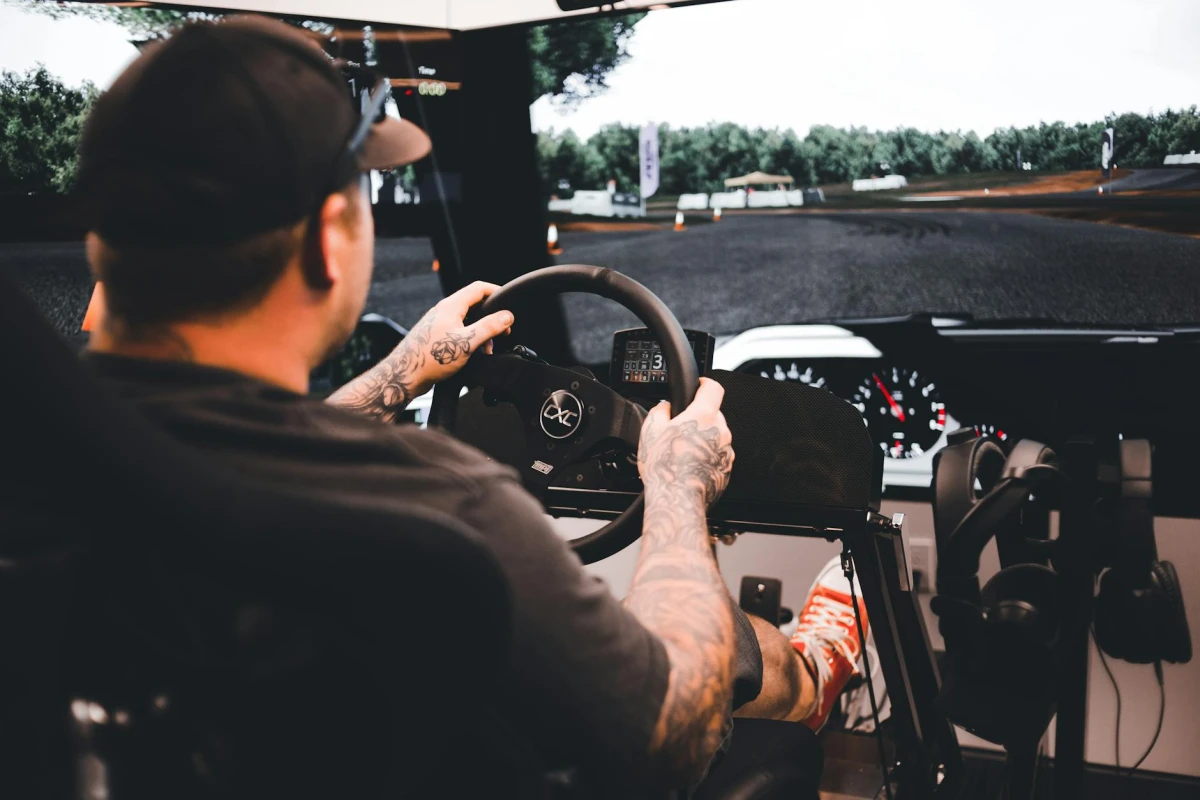
Sim drifting in 2026 looks nothing like it did a decade ago. It's no longer a Logitech G29 plus one Assetto Corsa mod. It's an ecosystem of direct-drive bases, hydraulic handbrakes, and dedicated drift servers where Formula Drift competitors do their off-week training.
This guide walks you from "does this even teach me anything?" to your first session on Ebisu Higashi. Along the way: which sim to pick, hardware on three budgets, Assetto Corsa setup step by step, technique, a 20-hour practice plan, and where the international sim-drift scene actually lives.
Does sim drifting actually teach you to drift for real
Short answer: yes, but not everything.
Piotr Wiecek and James Deane, two of the world's top Formula Drift competitors, use Assetto Corsa for between-event training. The reason is simple: repetition. At the track you might get a few dozen runs in a day. On the sim you can pull off 50 in an hour, on the same line, no tyre wear, no risk of bending sheet metal. Reading weight transfer, anticipating a slip, eyes on the exit, all of it transfers one-to-one from a virtual wheel to a real one.
The clearest proof showed up last year in the US. A sim champion known as Zack got behind the wheel of a real 900hp Nissan S15 in Formula Drift spec for the first time in his life, and after two laps was holding angle like he'd been driving the car for months. No nervous wheel jerks, no banging into walls. A coach from the Toyota Gazoo Racing GT Cup put it bluntly: the only differences are G-force and the fact that here you actually wreck the car if it goes wrong.
What sim won't teach you? Three things. First, the foot motoric on the brake. A load cell gives repeatability, but it can't replace the feel of the chassis inertia under throttle. Second, the cost of a mistake. In the sim you roll the car and hit Esc. At the track you roll the car and get an invoice. Third, G-force, the lateral pull in a corner glues you to the seat, and a sim can only show you the picture and the FFB. The rest, reading the balance, throttle modulation, counter-steer timing, planning a run, does carry over.
Which sim to pick in 2026
The market splits roughly into three realism tiers. The pick depends on whether you want to practice technique for real-world starts or just fire something up after work.
| Title | Realism | Steam price | Learning curve | Wheel support |
|---|---|---|---|---|
| Assetto Corsa | 10/10 | $25–40 (Ultimate) | Steep | Full, top-tier FFB |
| CarX Drift Racing 2 | 8/10 | ~$20 | Medium | Full |
| JDM: Japanese Drift Master | 6/10 | ~$30 | Easy (sim-arcade) | Full, anime vibe |
| Forza Horizon 5 | 4/10 | ~$60 | Very easy | Works, but pad is the standard |
| Drift Legends 2 | 3/10 | ~$12 | Arcade | Pad |
Assetto Corsa has been the gold standard for drift since 2014 and nothing has dethroned it. CarX holds its own as a sim-arcade hybrid with slip physics that drifters on Steam Community say "aren't far off AC." If you're torn between the two, we have a dedicated CarX vs Assetto comparison.
JDM: Japanese Drift Master, made by Polish studio Gaming Factory (released May 21, 2025), leans more manga vibe than coach, but its drift physics are surprisingly capable for an arcade-sim. Forza Horizon 5 is for the pad and the smoke screen, not for learning.
Why Assetto Corsa wins for learning
Three reasons AC stays on top.
Physics. Kunos's model remains in 2026 one of the most realistic in sim racing. Tracks and cars are laser-scanned, and Custom Shaders Patch adds physics extensions that the original engine never shipped with.
Mods. The drift community hosts hundreds of dedicated servers with regional filtering. Modded cars in Formula Drift spec, including Wiecek and Forrest Wang slot mods, download in five minutes, and you're driving the same setup the real pros use at events. Drift car and track libraries run into the hundreds, broken into packs of progressing difficulty.
Community. International AC drift is alive. ACS Drift Discord runs 400+ active servers, you can find a tandem partner at 10pm any night of the week, and setup help is one message away.
What about AC Evo, the new Kunos title? It exists, but not yet at full strength. For at least the next year the mod ecosystem and drift servers stay on AC1, and that's where you should start.
Hardware — three budgets, three real setups
| Budget | FFB base | Pedals | Handbrake | Total |
|---|---|---|---|---|
| ~$500 | Logitech G29/G920 (2.1 Nm) | Included | USB (Simsonn/Rastp) | ~$420 |
| ~$800 | Moza R5 Bundle (5.5 Nm DD) | Included | Moza HBP | ~$680 |
| $1,400+ | Moza R9 / Simagic Alpha Mini / Fanatec CSL DD 8 Nm | Load cell (Simagic P1000, Moza CRP) | Hydraulic (Simagic TB-1) | $1,400–2,400 |
Direct drive (DD) is the first real threshold. A non-DD base like the G29 puts force through helical gears, slow, missing detail, sometimes lagging on a sharp counter-steer. DD delivers the motor torque straight to your hands and you feel every change in grip. After one session on DD, going back to a G29 feels like watching TV with the colour off.
Load-cell pedals are the second threshold. A regular potentiometer measures travel distance and it's easy to overshoot the lock-up threshold. A load cell measures force. Repeatable braking pressure under threshold and throttle precision in the 70–85% band is what separates a session speedrunner from someone who actually controls angle.
A dedicated USB handbrake isn't required, but it cuts weeks off the transitions learning curve. A keyboard key or a wheel button works, but you can't feel how deep you've pulled.
~$500 — entry into the hobby
The Logitech G29 (PC/PS) or G920 (PC/Xbox) is still the most-bought starter wheel. New it runs ~$260, used in good condition $120–165 on the secondhand market. 2.1 Nm FFB through helical gears, a long way from DD, but enough to learn to read a slip. Pedals included (potentiometer, not load cell), desk clamp, optional shifter.
Add a cheap USB handbrake, Simsonn or Rastp for $60–80. Total $350–420 and you're driving. Don't expect feedback miracles, but for the first 50 hours it's a setup that doesn't hold you back.
One downside: the G29 ages fast on the pedal side. Throttle spring loosens, brake loses repeatability. When budget allows, replace the pedals first, long before the wheel.
~$800 — direct drive for real
The Moza R5 Racing Bundle is currently the most reasonable value-for-money pick under sim drift. Roughly $400–520 (depending on region and promotions) for a 5.5 Nm DD base, ES 11" wheel, SR-P Lite pedals, and a desk clamp. Plus the Moza HBP handbrake at ~$135, USB-C, mounts vertically or horizontally.
R5 has infinite rotation. You set the maximum lock in the Pit House app. For AC drift mods, set 900–1080° and forget it. The FFB is in another league from a G29, you feel when the rear axle starts to drift before the car actually goes sideways.
This is the first budget at which the sim genuinely starts training track-applicable technique. Counter-steer feedback works like in a real car, faster than you can consciously react, but in a way the reflex builds itself. If a Moza R5 means you're also thinking about a real car, check our BMW E36 drift build guide, that's the classic first real build.
$1,400+ — the rig for an ACS server resident
Here the configurations spread out. Stronger DD bases: Moza R9 (9 Nm), Simagic Alpha Mini (10 Nm), or Fanatec CSL DD with the boost kit (8 Nm), $660–1,060 for the base alone. Load-cell pedals: Simagic P1000 or Moza CRP, add $350–590. Hydraulic handbrake, the Simagic TB-1 with a real brake cylinder, ~$235, gives you exactly the same lag profile as real hydro.
An aluminium cockpit (Sim-Lab, Trak Racer) at $470–820 adds the rigidity a desk clamp can't. Vibrations stop, the base stops "swimming" under heavy FFB.
This setup is an investment for regular Virtual Drift Masters–league starts. If that's not the plan, the R5 is plenty.
Setting up Assetto Corsa step by step
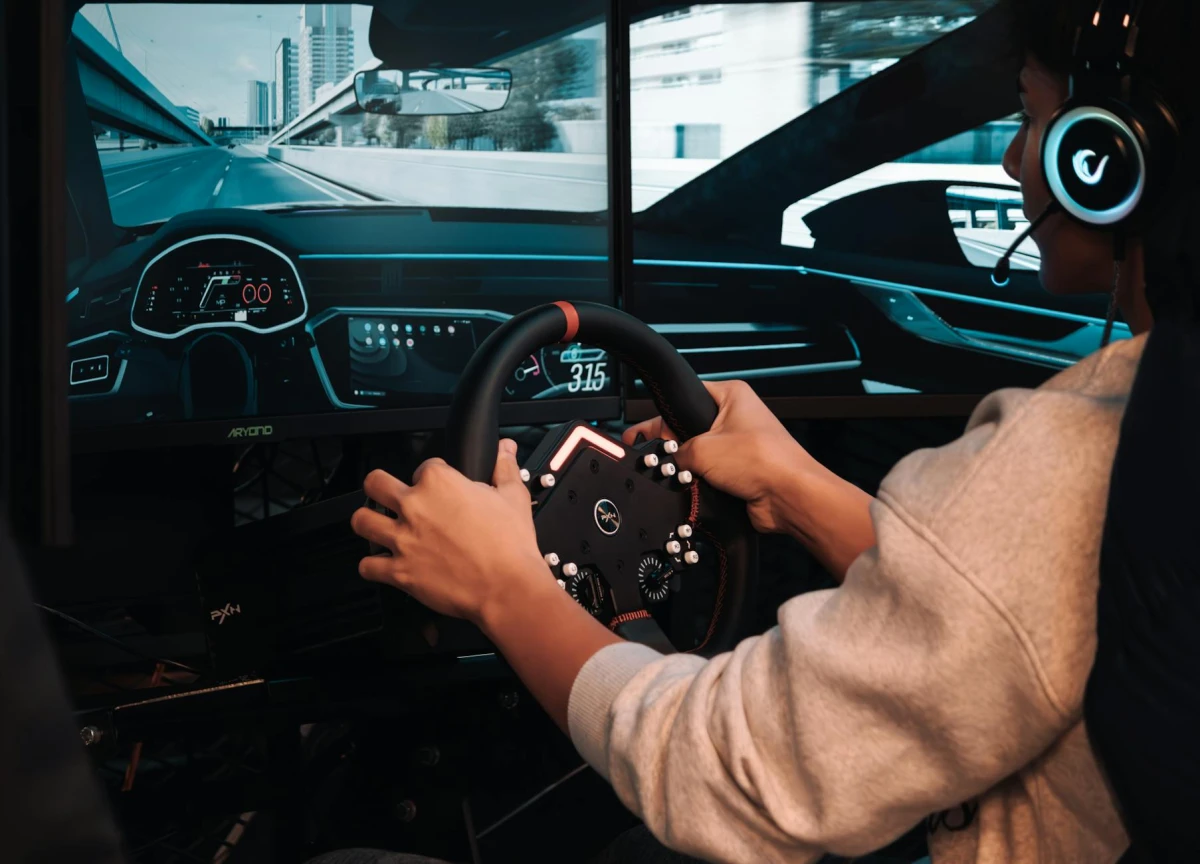
AC bought from Steam is just the start. To drift you need three things: Content Manager, Custom Shaders Patch, and an ACS Drift server.
1. Content Manager. Download from acstuff.club (the official source). Windows SmartScreen will block it, click "More info" and "Run anyway." CM replaces the original AC launcher and gives you a sane UI for managing tracks, cars, and online servers.
2. Custom Shaders Patch. In Content Manager: Settings → Custom Shaders Patch → Install. One click. CSP adds a new shader pipeline, dynamic lighting, better tyre smoke, and most importantly several physics extensions the original engine never had. Without CSP most drift mods won't run properly.
3. ACS Drift server. Go to acsdrift.com, register, join the Discord. From inside Content Manager you filter servers by region and click Join. The first login verifies your Steam account.
Minimum specs for 2026: Windows 10/11, 16 GB RAM, GPU class GTX 1060 / RX 580 or better, SSD (AC mods together easily eat 100+ GB).
Wheel and FFB settings
Each manufacturer has its own. Three most common setups:
Logitech G29 / Thrustmaster T300. In the manufacturer panel (Logitech G HUB / TM Control Panel): gain 100%, damper 0%, spring 0%, sensitivity 50%, max angle 900°. In AC: Settings → Controls → pick the "G29" preset, then push FFB to 100% gain, 0% min force, dynamic damper off.
Moza R5 / R9. Calibrate in Pit House: max angle 900–1080°, FFB ~80%, damper 5%, spring 0%, road effect 30%. In AC leave the default Moza profile, enable Custom FFB in CSP for extra slip feedback.
Fanatec CSL DD / GT DD Pro. On the wheel tuner: SEN AUTO, FF 100, NDP OFF, NFR OFF, NIN OFF, INT 11, FEI 100. In AC set FFB gain to 90%.
Common to all: damper and spring at 0. You want a free wheel that returns easily, because counter-steer in drift is hand work, not a fight against the FFB motor.
Starter car and its setup
BMW E30 Drift, stock in base AC. Don't overthink it. This is the car everyone learned on.
Settings: Street 90s tyres (not semi-slicks, you want traction to break easier than in real life), 39 psi all corners, ABS off, traction control off, FFB gain 100%.
After the E30, don't jump straight to high-grip. Step two is the lighter drift packs, Gravy Garage, WDT, or Swarm. Cars with moderate power and forgiving setup, where you learn to link corners without fighting traction. Only then DCGP (Drift Corner Grand Prix), 30+ drift cars with set steering angles and strong turbos. This is the hardest tier, because high grip demands precise throttle control. Finally a jump to the Wiecek Nissan Silvia S15 mod (assettocorsamods.io), 600hp SR20, geometry like a real FD spec car.
The order matters. E30 → Gravy Garage / WDT / Swarm → DCGP → S15 is the path on which every step builds on the habits of the previous one.
Drift technique in the sim — from your first chicane to smoke over the wall
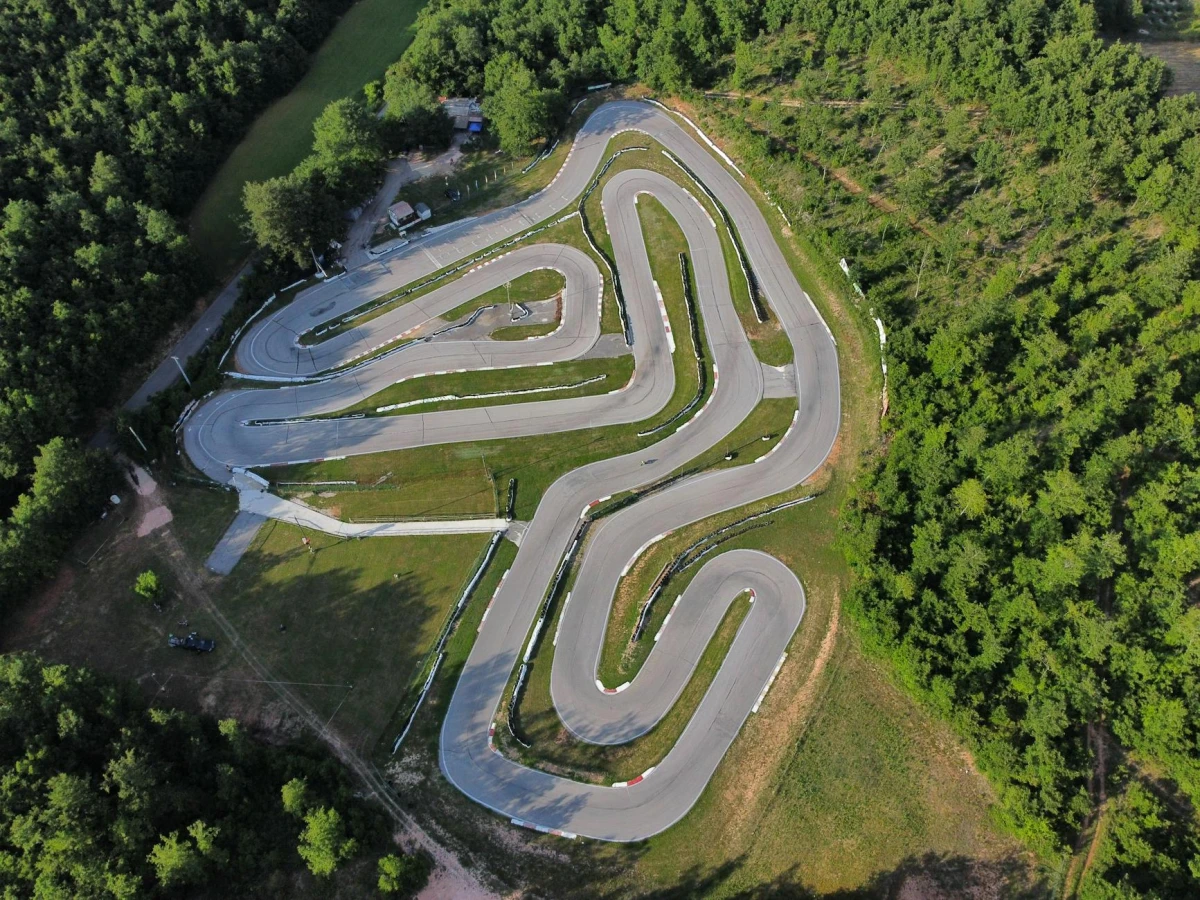
Four techniques in learning order: initiation, counter-steer plus throttle, transition, exit.
Initiation is putting the car into a slip. On the E30 the simplest method: short handbrake pull at 60–80 km/h while you yank the wheel toward the corner. The car oversteers, immediately counter-steer plus throttle to hold the angle. On more powerful cars (S15, Supra) clutch kick also works: clutch in, rev to 5–6,000, dump it, the rear tyres break loose. A Scandinavian flick, a yank in the opposite direction before the actual turn, shifts weight to the outside and makes initiation easier without using the handbrake.
Counter-steer plus throttle modulation is the whole point. The goal: a constant steering angle at the wheels with variable throttle. You read slip angle off the FFB and the picture. Too much throttle and the angle opens up, you slide wider. Too little and the angle closes, you straighten out. Left foot on the brake works as a micro-correction, short taps slow the rotation and let you tighten the line.
Transition is moving from a right-hand slip to a left-hand slip (or the other way). The key: take the angle all the way through one side, then straighten and flick to the other, no flat moment in between. Figure-8 (two corners in opposite directions joined into a figure of eight) is the standard drill. Thirty minutes of figure-8 a day for a week and transitions become reflex.
Exit is the moment you close the angle and put the car back onto the straight. This is where most beginners stuff it into a wall. Look at the exit point two corners ahead, where you want the car to straighten. Eyes lead the hands.
Practice plan for the first 20 hours
Stick to the sequence. Don't skip stages.
Hours 1–3: donuts around a single object. E30, Street tyres, an open spot in Drift mode. Drop a cone or any reference point and circle it in a steady, controlled slip. First clockwise, then counter-clockwise. The goal: hold angle and radius across a full revolution, throttle and counter-steer in balance. This is the foundation everything else builds on, without stable donuts you won't hold a full corner.
Hours 4–8: figure-8. Two cones 30 metres apart, drive a figure of eight. Each direction change is one initiation plus one transition. This drill builds the muscle memory for counter-steer and the car's weight.
Hours 9–15: three corners in a row on a real track. Ebisu Higashi (a mod of one of Japan's most famous drift tracks) or any mod with a Drift Layout, link entry, mid, exit without straightening. After every run, pull up throttle/angle data in Content Manager telemetry and look for spots where the angle closes or throttle drops.
Hours 16–20: join a public ACS Drift server. Pick a quiet one (filter by player count: 2–4), tandem behind the leader for a few laps. Don't try to outrun him. Copy his line, hold half a car length.
Consistency drill: drive one lap a second slower than your best lap for 30 minutes. Builds repeatability faster than chasing time.
The most common beginner mistakes
Six things that break progress in the first 50 hours.
Over-correction. The car slips, you panic, you give full lock the other way, and you're in the opposite wall. Counter-steer should be proportional to angle, not maxed out.
Too much throttle on initiation. Full throttle the moment you pull the handbrake means you can't react when the rear breaks loose. Start at 60–70% and work up to full once the angle is set.
Releasing the handbrake too early. Let it go before the angle is set and the car straightens out. Hold it until the angle stabilises at where you want it.
Too much car at the start. A 600hp S15 sounds exciting. It also forgives nothing. Go back to the E30 until you can hold a full lap clean.
No wheel calibration. Default 270° rotation in Logitech G HUB is a complete failure under drift. 900° absolute minimum, 1080° recommended.
Chasing the visual instead of the technique. Smoke clips on YouTube look great. Clean repeatability across five corners in a row leaves 90% of ACS servers behind you. Quality before spectacle.
The classic stuck path: "I can throw a chicane or two sideways but I can't hold the slip." The fix is always the same. Back to the E30, one corner, 50 clean repeats.
The sim drift community — where to drive, with whom, and what to compete in
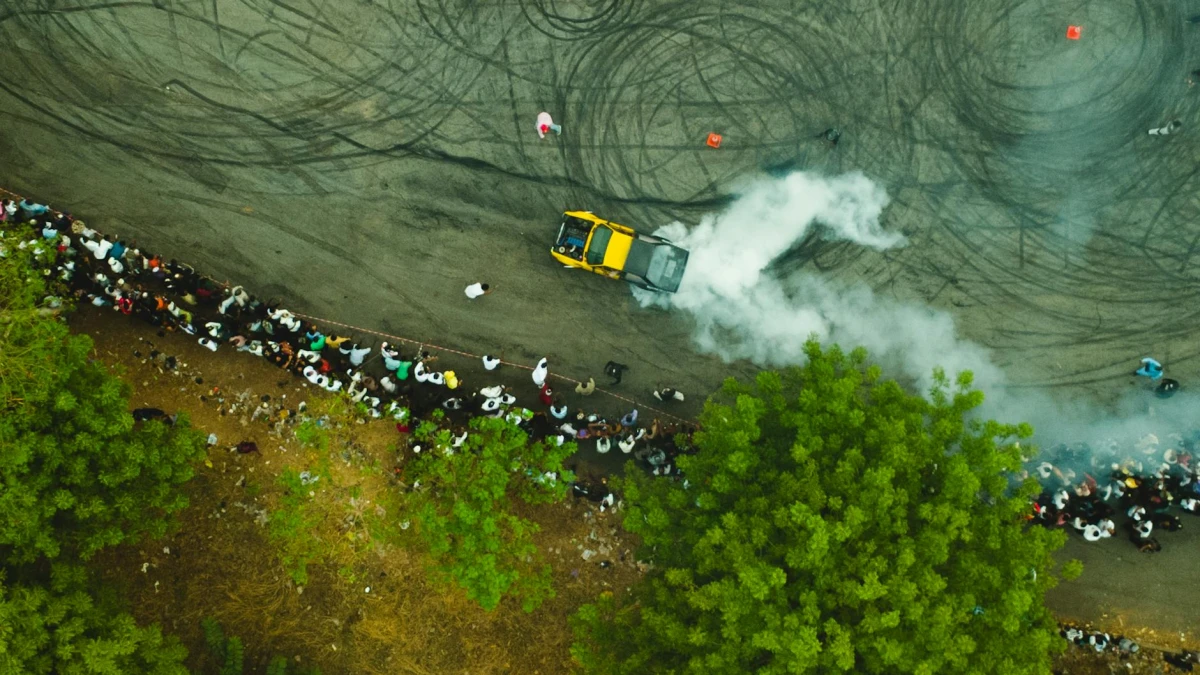
International sim drift in 2026 is healthier than it's ever been. Three places worth knowing.
ACS Drift Discord. The main hub for AC drift players globally. Lobbies for finding servers, channels for tandem matchmaking, setup help in dozens of languages. If you only join one community, this is the one.
Reddit and the drift subreddits. r/simracing for hardware questions, r/drifting for technique and IRL crossover, the Assetto Corsa subreddit for mod recommendations. Search before you ask, most beginner questions have ten threads of answers already.
Virtual Drift Masters (vdm.gp). The most serious international sim drift league. The 2025 season ran seven rounds with a €15,600 prize pool, €1,000 for the round winner (€600 for second, €200 for third). Polish drivers were the largest national group, 10 of 52 competitors (19%), including Robert Kwieciński and Krzysztof Rypina. If you want to eventually compete in VDM, the path is: 100+ hours in AC → a local league → VDM qualifiers. The format mirrors real-world Drift Masters European Championship, TOP 32, TOP 16, TOP 8, final. Same judging system, same rules.
From simulator to real track
What carries over one-to-one and what doesn't.
Carries over: reading weight transfer, anticipating the moment grip breaks, throttle modulation in the 60–90% band, eyes on the exit point, planning a run, counter-steer timing, reading a tandem partner's position.
Doesn't carry over: G-force pulling you into the seat (sim won't replicate that even with a motion rig), foot motoric on the hydraulic handbrake, engine sound and vibration that tell you revs (you learn to watch the shift light), the cost of a mistake (sim Esc, real-world invoice).
The path I recommend: 50–100 hours in the sim (E30 → lighter drift packs → DCGP → Wiecek S15) → drift taxi with an instructor (1–2 sessions, $50–100) → a drift school in your country (search for "drift experience" or "drift school", most major regions have at least one) → your first real car from the marketplace.
Research on training simulators (Allen Berg Racing Schools uses sim as a standard training tool) confirms what the community has seen for years: sim plus real sessions teach faster than real sessions alone. With the awareness that the sim never replaces track time, it just prepares you for it well.
The classic first real drift car is a BMW E36 (entry $2,000–3,500, mountains of replacement parts) or a Mazda MX-5 NA/NB (light, mellow, forgiving). An E30 in driftable condition is hard to find these days, it's become a collector's piece.
After a season in the sim — time for a real car
Browse drift cars on DriftHub. BMWs, Nissans, Toyotas ready for handbrake and hydro.
Frequently asked questions
Can you drift without a wheel, on a controller?
Yes. Forza Horizon 5 and CarX Drift Racing 2 are pad-friendly, the physics are tuned for analog sticks. In Assetto Corsa a pad will also work with assist scripts like A7 Assist, but FFB precision suffers and you won't learn to read a slip with your hands. Pad is fine for fun. A wheel is needed to learn technique that carries to a real car.
Is a handbrake required to learn?
No. You can initiate with a flick (weight transfer) and clutch kick (on stronger cars). But a dedicated USB handbrake at $70–135 dramatically cuts the transitions learning curve. A keyboard key only works as on/off, and in drift you need modulation.
How long until I can hold a continuous drift?
On the E30 plus Street tyres, 5–15 hours to your first stable lap in drift mode. 30–50 hours before you can join public ACS servers without being dead weight. 100+ hours before you start chasing times in a league.
Will Assetto Corsa Evo replace AC1 for drift?
Not yet. AC1 has the entire ecosystem, mods, ACS servers, the drift community. AC Evo is still building content, with no drift servers, no Wiecek mod, no DCGP. In 2026 you still start on AC1.
How much does sim drifting cost at the minimum?
A computer (16 GB RAM, GTX 1060, SSD) plus a Logitech G29 ($260 new, $35). Total $470–600 if you already have the computer.$140 used) plus a cheap USB handbrake ($70) plus AC Ultimate on Steam (